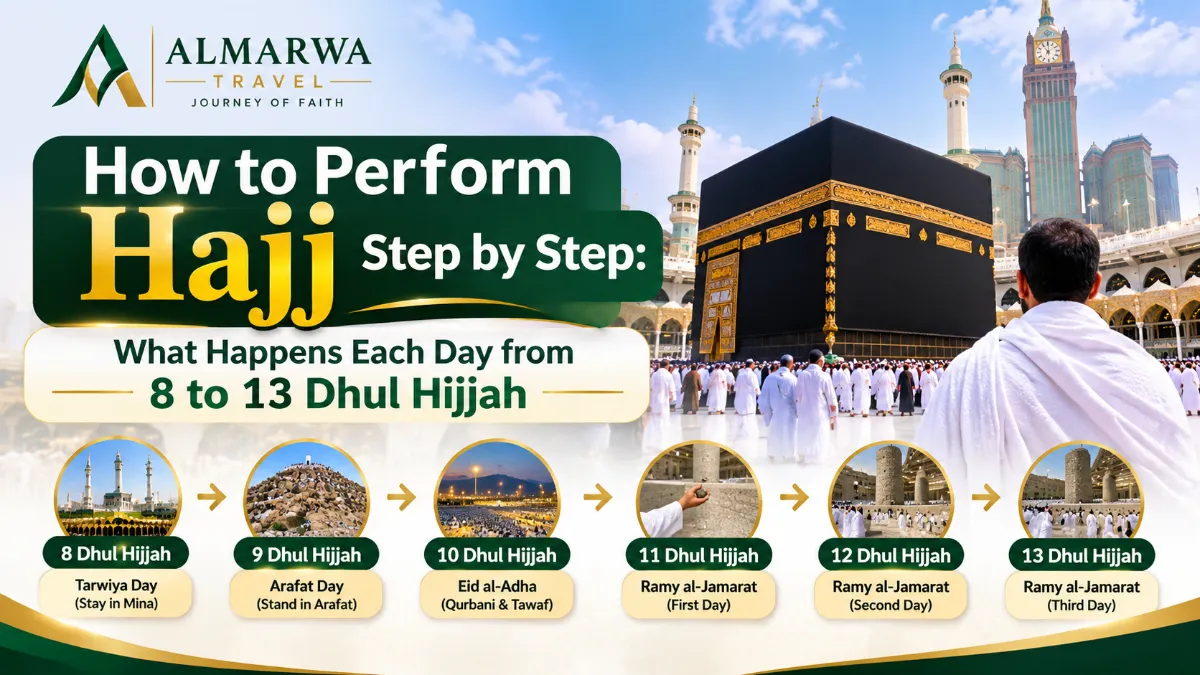
Hajj step by step is easiest to follow when you see the full sequence before you travel. The core rites of hajj take place over six days, from 8 to 13 Dhul Hijjah, and each day has a specific location and purpose. Planning for Hajj 2027 starts with understanding this timeline, along with your permit and booking steps on the official Nusuk platform. This guide follows the rites in the order they happen, so you can prepare with confidence.
In brief: on the 8th you go to Mina; on the 9th you stand at Arafah and spend the night at Muzdalifah; on the 10th you throw pebbles at Jamrat al-Aqaba, sacrifice, shave or trim, and perform Tawaf al-Ifadah; on the 11th to 13th you return to Mina for the Days of Tashreeq; and before leaving Makkah you perform Tawaf al-Wada.
Before any of this, you need to know which of the three types of Hajj Packages you are performing (Tamattu, Qiran or Ifrad), because it changes your sequence and whether you must offer a sacrifice.
Before Hajj: Ihram, Niyyah and the Three Types of Hajj
Ihram is the sacred state you enter before performing Hajj or Umrah. It begins with niyyah (intention) and the talbiyah: "Labbayk Allahumma labbayk." Men wear two unstitched white cloths and keep the head uncovered. Women wear modest, loose clothing and keep the face and hands uncovered, but they do not wear a face veil or gloves. While in ihram, you avoid cutting hair or nails, using perfume, hunting, and marital relations.
There are three ways to perform Hajj:
- Tamattu (the most common choice): You perform Umrah during the Hajj months (Shawwal, Dhul Qa'dah and the first ten days of Dhul Hijjah), exit ihram, and then re-enter ihram for Hajj on 8 Dhul Hijjah from Makkah. You must offer a sacrifice (hadi) unless you are a Makkah resident. Most first-time pilgrims choose Tamattu because restrictions ease between the two rites.
- Qiran: You combine Hajj and Umrah under a single ihram and remain in ihram until after the rami on the 10th. A hadi is required.
- Ifrad: You perform Hajj alone, without Umrah first. A hadi is not required, and you may perform Umrah afterward.
Confirm your type with your Hajj operator early. It affects your sacrifice arrangements, your timing, and your rami schedule.
Day 1 (8 Dhul Hijjah): Going to Mina
The 8th is known as Yawm al-Tarwiyah. After wudu and ihram, you renew your niyyah for Hajj in Makkah (for Tamattu pilgrims, from their accommodation) and travel to Mina before Dhuhr.
In Mina, you pray Dhuhr, Asr, Maghrib, Isha and Fajr at their proper times. Travelers shorten four-rak'ah prayers to two, and on this day the prayers are not combined. You spend the night in Mina.
Use this day to rest and make dhikr. Mina tents are crowded, so keep your documents, water and medication in a small bag you can carry at all times.
Day 2 (9 Dhul Hijjah): The Day of Arafah
After sunrise, travel to Arafah. The Prophet ﷺ said, "Hajj is Arafah" (narrated by al-Tirmidhi). Standing at Arafah is the core of Hajj, and without it the Hajj is not valid.
At Arafah, Dhuhr and Asr are combined and shortened, offered at the time of Dhuhr. You must be present in Arafah from after midday until sunset. The valid window continues until Fajr of the 10th, but most scholars advise against leaving before sunset.
What to Do at Arafah
- Know the boundary. Arafah has a defined area. Ask your guide where your tent is and stay within the boundary.
- Plan for heat. The sun is intense. Bring water and electrolytes, keep your head covered as permitted, and rest in shade when you can.
- Prioritize worship. Focus on dua, istighfar, Quran and dhikr. Limit phone use and charge a power bank before the day.
- Stay with your group. Note your tent number and keep your ID or wristband on you.
- Jabal al-Rahmah is optional. Climbing the mountain is not part of the obligatory rites. Many pilgrims skip it because of the heat and crowds.
Duas for Arafah
Arafah is the best day for supplication. Two well-known supplications are:
- The best dua of Arafah, narrated in al-Tirmidhi: "La ilaha illallah wahdahu la sharika lah, lahul mulk wa lahul hamd, wa huwa 'ala kulli shay'in qadir."
- The Qur'anic supplication (2:201): "Rabbana atina fid-dunya hasanatan wa fil-akhirati hasanatan wa qina 'adhaban-nar."
Before the day, write a list of people and needs you want to remember: parents, family, friends, the ummah and your own goals. Under emotion, it is easy to forget what you planned to ask for.
Night at Muzdalifah
After sunset, depart Arafah for Muzdalifah, which lies between Arafah and Mina. There you pray Maghrib and Isha combined at the time of Isha (three rak'ah for Maghrib, two for Isha), rest, and pray Fajr.
This is the place to collect pebbles for the rami. Collect about 70 small pebbles, roughly the size of a chickpea. The number matters because you need 7 for Jamrat al-Aqaba on the 10th, and 21 for each Day of Tashreeq you stay (49 if you leave Mina on the 12th, 70 if you stay until the 13th). It is wise to collect extra.
Elderly people, the weak, and those with young children may leave Muzdalifah after midnight, according to many scholars. Confirm this with your group leader.
Day 3 (10 Dhul Hijjah): Rami, Qurbani, Halq and Tawaf al-Ifadah
The 10th is Eid al-Adha, and it contains four rites. The usual order is:
Rami Jamrat al-Aqaba
Throw seven pebbles, one at a time, saying "Allahu Akbar" with each throw. Go after sunrise if you can, because crowds grow toward midday.
Qurbani (hadi)
Tamattu and Qiran pilgrims must offer a sacrifice. Operators typically arrange this through official channels, and it can be done from the 10th to the 13th.
Halq or taqsir
Men shave the head (halq is preferred) or cut the hair evenly (taqsir). Women trim a fingertip's length from the ends of their hair.
Tawaf al-Ifadah in Makkah
Perform seven circuits around the Kaaba. Tamattu pilgrims do not repeat sa'i because they completed it during Umrah. Ifrad and Qiran pilgrims perform sa'i after this tawaf if they have not done it yet. After halq and Tawaf al-Ifadah, most restrictions of ihram are lifted.
Many pilgrims perform Tawaf al-Ifadah later during the Days of Tashreeq to avoid the peak crowds. The rules on delaying it differ between schools, so check with your scholar or operator before doing so.
Days 4 to 6 (11 to 13 Dhul Hijjah): Days of Tashreeq
These three days are spent in Mina. After midday (zawal), perform the rami at all three pillars in order:
- Jamrat al-Ula (the smallest), seven pebbles.
- Jamrat al-Wusta (the middle), seven pebbles.
- Jamrat al-Aqaba (the largest), seven pebbles.
After the first two, make dua standing toward the qibla with your hands raised. You do not stop for dua after Jamrat al-Aqaba.
On the 12th, you may leave Mina before sunset (nafr awwal). If the sun sets while you are still in Mina, you must stay for the 13th (nafr thani) and perform the rami again.
Rami by proxy: If you are ill, elderly, pregnant, or have a child who cannot throw, you may appoint someone to throw on your behalf. Most scholars say the proxy should first throw for themselves, then for you.
Crowd safety: Stay with your group, use the designated levels, keep your belongings secure, and avoid pushing. Going during quieter periods reduces risk.
Farewell Tawaf
Tawaf al-Wada is the last act performed before leaving Makkah. It consists of seven circuits around the Kaaba, performed shortly before your departure. Menstruating women and women with postpartum bleeding are exempt. Plan your departure so that this is your final act in Makkah.
Hajj Day-by-Day at a Glance
| Date (Dhul Hijjah) | Location | Main Rites | Key Reminder |
|---|---|---|---|
| 8 | Makkah to Mina | Ihram with Hajj niyyah; five prayers in Mina | Reach Mina before Dhuhr |
| 9 | Mina to Arafah to Muzdalifah | Stand at Arafah from midday to sunset; night at Muzdalifah; collect pebbles | Do not leave Arafah before sunset |
| 10 | Muzdalifah to Mina to Makkah | Rami Jamrat al-Aqaba (7); sacrifice; halq or taqsir; Tawaf al-Ifadah | Ihram is largely lifted after halq and tawaf |
| 11 | Mina | Rami all three jamarat after midday | Dua after the first two |
| 12 | Mina | Rami all three; leave before sunset if you choose | Nafr awwal |
| 13 | Mina | Rami all three; leave Mina | Nafr thani if you stayed |
| Before departure | Makkah | Tawaf al-Wada | Exempt: menstruating women |
At Al Marwa Travel, our Hajj packages are planned around these rites, with accommodation in Makkah and Madinah, Mina arrangements, transport between the holy sites and guidance from experienced group leaders.
View Hajj PackagesFrequently Asked Questions
How many days does Hajj take?
The core rites take place over six calendar days, from 8 to 13 Dhul Hijjah. Most pilgrims spend two to three weeks in total, including travel and a visit to Madinah, depending on their package. See our 2–3 weeks non-shifting Hajj package for an example.
What are the pillars of Hajj?
Scholars commonly list four pillars: ihram (niyyah), standing at Arafah, Tawaf al-Ifadah, and sa'i. The schools classify sa'i differently. The Hanafi school treats it as obligatory (wajib) rather than a pillar, so missing it requires a sacrifice rather than invalidating Hajj.
What is the difference between Hajj Tamattu and Qiran?
Tamattu involves performing Umrah during the Hajj months, exiting ihram, and then re-entering ihram for Hajj on the 8th. Qiran combines Hajj and Umrah under one ihram, and the pilgrim remains in ihram until after the rami on the 10th. Both require a sacrifice. Tamattu is generally easier for first-time pilgrims because restrictions lift in between.
What happens if you miss Arafah?
Standing at Arafah is essential. If you miss it, your Hajj is not valid. Most scholars advise performing Umrah (tawaf, sa'i and halq) to exit ihram, then making up Hajj in a future year, usually with a sacrifice. Speak to a scholar or your operator immediately.
Can someone else throw the pebbles for me?
Yes, if you have a valid excuse such as illness, old age, pregnancy, or a young child. The proxy should throw for themselves first, then for you.
Do I need to do Umrah before Hajj?
No. Umrah is required only as part of Tamattu, where it is performed during the Hajj months. Umrah outside the Hajj season is a separate act of worship and is not a prerequisite for Hajj. If you plan to perform Umrah before Hajj, read our Complete Umrah Guide first.
Do I need a Nusuk account for Hajj?
Pilgrims performing Hajj need an official permit, and Nusuk is the platform used for official Hajj services. Your Hajj operator usually guides you through the registration and permit steps, but you should check your own account, personal details and permit status on Nusuk before you travel.
When is Hajj 2027?
Hajj 2027 is expected around mid-May 2027, subject to the moon sighting for Dhul Hijjah. The official dates are announced by the Saudi authorities closer to the time, so plan around the estimate and confirm the final dates before booking.
Conclusion
Hajj becomes manageable when you know the sequence. Decide your type of Hajj early, understand what each day requires, and prepare for heat, crowds and long walks. Keep a copy of this timeline with you, and use the dates above as your planning anchor.
If you are still deciding how to plan your journey, our Hajj packages are designed around these rites. For a longer overview of the timeline and preparation, read our Hajj 2027 guide.
Sources
- Hajj permits and services: the official Nusuk Hajj platform (hajj.nusuk.sa)
- "Hajj is Arafah": Jami' al-Tirmidhi
- Dua of Arafah: Jami' al-Tirmidhi
- Qur'anic supplication: The Quran, Surah al-Baqarah 2:201